SMBs – Fraud and Security
1 in 2 SMBs were fraud targets this year. In this month’s update, we highlight 5 small business scams and 6 thing small businesses need to know about security. Click here to dive into the articles.
1 in 2 SMBs were fraud targets this year. In this month’s update, we highlight 5 small business scams and 6 thing small businesses need to know about security. Click here to dive into the articles.
Have you or your employees ever left their laptop in a coffee shop? Or maybe even the airport? Losing or having your hardware stolen can be an inconvenience but what about the data?
In this month’s update, get tips on hack proofing your hardware. We also have ways to maximize your storage and a short video discussing change in your business. Click here to read the update.
Bad actors love to take advantage of people during hard times. COVID has been no exception. This month highlights COVID related scams targeting your employees. Click here to read the latest tech update.
Buying the right equipment is a crucial part of your business. Higher quality equipment can increase productivity and give you a competitive edge. Buy buying used or low cost, you run the risk of spending more in the future. Find out more in our tech update here.
If your company had an IT disaster, would you know what to do? Does your IT partner have a plan for your business? During a disaster is not the time to create your emergency plan. This month ,we have a short article on how to keep your cool during an IT disaster. Read it here. If you would like somebody to review your disaster plan, head on over to our contact us page and let us know. We’d be happy to help!
COVID-19 has caused so much uncertainty and has forced many businesses to quickly change their way of doing business. In this months articles, we have three ways leaders should pursue innovation in a crisis. Check them out here.


Companies should get ready as crime rings plan to take their data hostage when employees slip up
By Jack Skinner
President and Founder
Oversee My IT
Small healthcare companies need to rethink their network security as criminal groups use new tactics to take their sensitive data
Ransomware, which was already a problem, is getting worse because technology tools that health businesses are adding, such as remote work, create new places to attack their systems.

In a study of 127 ransomware attacks against healthcare companies between 2016 and 2019, 70 percent were directed at shops with fewer than 500 employees, according to a report from security provider RiskIQ.
That’s because small providers typically have limited safety measures for their data.

Direct patient care facilities like hospitals “are more likely to pay (ransoms) to prevent disruption to patient care,” RiskIQ reported.

Mistakes a growing problem
As Covid-19 makes smaller shops put more data on the Internet, criminals are stealing credentials to break into their web applications.

And while internal actors account for many healthcare breaches, employee error is increasingly how bad guys get their hands on key information.
Some 31 percent of healthcare breaches this year are due to staff mistakes, compared with 22 percent across all industries, according to a Verizon study.

Covid is partly to blame because of stress and fatigue it is causing for people in the field.
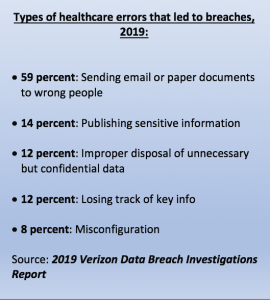
But like industries such as finance, security glitches in healthcare often start with problems in workflow, communication, judgment, corporate culture – things that can’t be solved by buying a new technology tool.

How hackers get in
Employees are often unaware of miscues they have made that expose sensitive data to law breakers.
The most common oversight in 2020 is sending emails or paper documents to the wrong people, according to Verizon.

Some 14 percent of cybersecurity professionals say attacks that exploit short-staffed tech and security departments are the elements of the Covid-19 crisis that are most likely to increase risk to their enterprises.

Another is losing track of where key data is stored, such as putting medical records in a file and forgetting where it is.
Technology staffers since 2017 have increasingly left data-storage devices vulnerable on the Internet, according to Verizon.

Researchers forecast a rise phishing emails aimed at stealing credentials from overworked information-technology professionals.
The U.S. Secret Service has warned of emails from criminals posing as officials of the Centers for Disease Control and the World Health Organization.
Ransoms may replace inside jobs
Ransomware will likely rise as organizations add more connections to their networks, whether mobile devices, patient portals and other ways to interact with those they do business with.

As errors open more doors to intruders, healthcare may be seeing a decline in thefts caused by insiders like executives or doctors.
Privilege misuse accounted for 23 percent of attacks on healthcare organizations in 2019, versus 8.7 percent this year.

That may be partly because some companies are getting better at detecting breaches.
This year, organizations with fewer than 1,000 employees have been more likely to discover breaches in days, where big companies more often have taken months or years, according to Verizon data.
How to protect your company

Addressing security gaps on a network requires understanding:
Even at businesses with fewer than 10 employees, managers are often surprised what security evaluations find in their information systems.
Technology improvements should coincide with updated training for both lay and IT staffers on recognizing criminal behavior and what to do about it.

Audits on how information moves from one employee to another can help spot gaps that hoodlums may target.

These steps should extend to cloud services that providers may use going forward.
Contact Jack Skinner at Info@OverseeMyIT.com.
About Jack:
Washing your hands is more important than ever, but so is being diligent about cyber and personal security.
With many counties and cities under a “Stay at Home” order, working from home in the current times means something different than it did before.
The added stress alone is enough to make a mistake, without mentioning the added multi-tasking while still trying to do our jobs and stay connected to our teams and others. So what are the bad guys doing? Taking advantage.
Make sure you are only opening emails and attachments that you were expecting, you are only clicking on and signing into trusted sites and that you are careful what you sign up for.
By setting up accounts on the fly, you are potentially exposing yourself to the outside world. For example, when you set up a free Zoom account instead of signing up for Microsoft teams for video conferencing.
Clicking an unknown link or unsafe site could make your computer and network sick and could cause financial or legal harm for years to come.
The bad guys are also coming after you personally. Be extra cautious regarding fake emails (for example, verifying information for your stimulus check) , do not give out personal information over the phone and be mindful of people price gouging and selling counterfeit items such as sanitizer and Personal Protective Equipment.
What can you do to prevent this?
Consult a professional or someone with experience in the area before signing up or setting up an application or service. If you don’t have a trusted professional, you can send us a message here.
Sources:
FBI warns of Teleconferencing and Online Classroom Hijacking During COVID-19 Pandemic: https://www.fbi.gov/contact-us/field-offices/boston/news/press-releases/fbi-warns-of-teleconferencing-and-online-classroom-hijacking-during-covid-19-pandemic
FBI Sees Rise in Fraud Schemes Related to the Coronavirus Pandemic: https://www.ic3.gov/media/2020/200320.aspx